Showing posts with label architectural details. Show all posts

Monday, April 26, 2010

Custom Doors


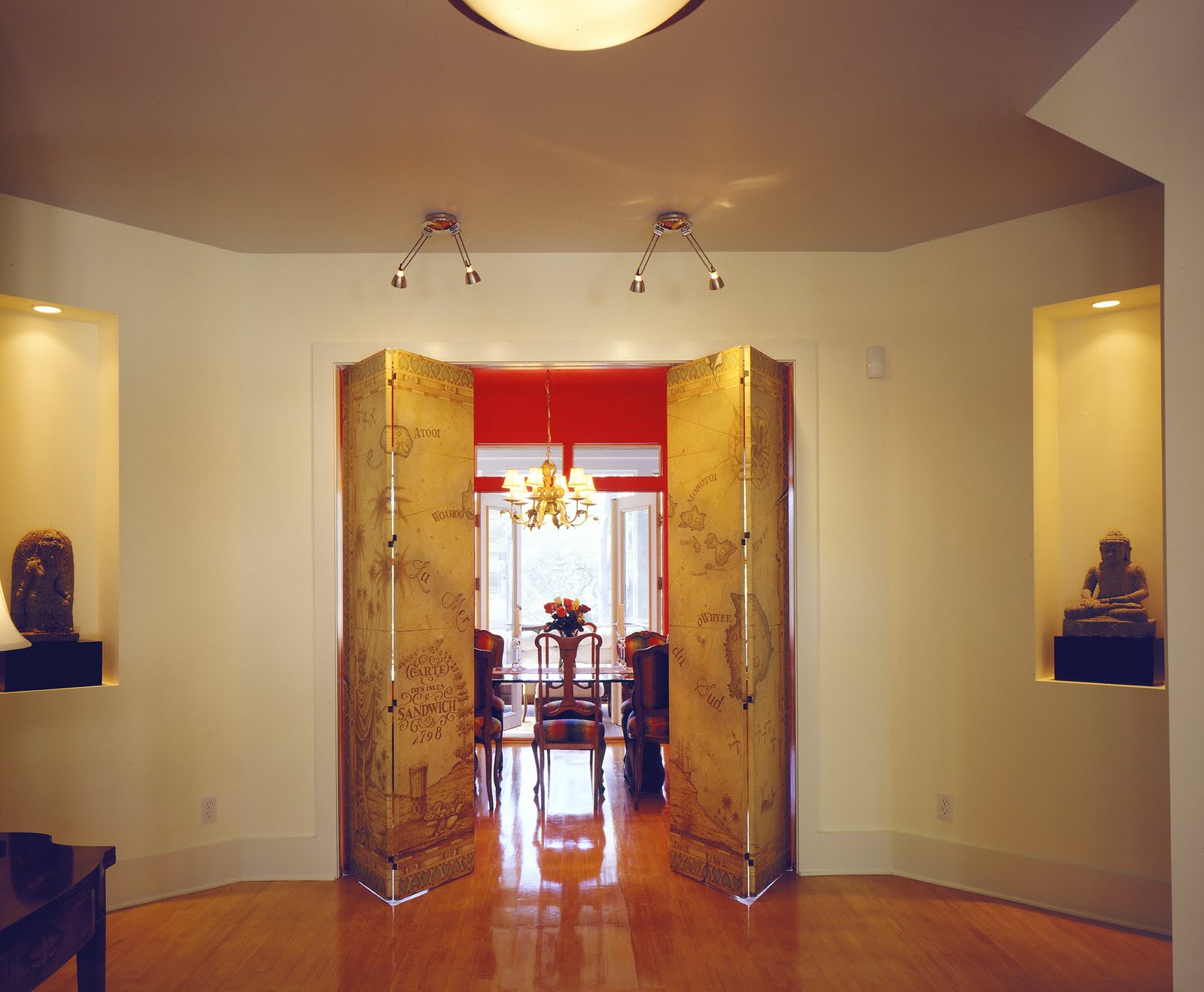
These doors have an old map of Hawaii on them. They were designed as a screen for a stage set. We re-worked them as folding doors. They are normally kept shut and only opened to reveal the dining room when the owner has a dinner party. Very dramatic!

Saturday, September 26, 2009

Residential Lighting


Residential lighting is best when a variety of light sources provide the necessary illumination for daily activities, the occupant’s ages and physical limitations. There are five types of lighting that when layered provide usable light for day to day activities; all spaces may not need all types of lights.

Task Lighting is the lighting
that illuminates the area where you are working or reading. These fixtures include under cabinet lights and reading lights. Ambient Lighting is the gentle overall lighting for the room. This light fills the room with a warm glow from an indirect light source that is bounced off the ceiling. Cove lighting, pendant hung indirect fixtures, and opaque wall sconces are some of the ambient light fixtures. Accent Lighting is the dramatic light. These lights highlight works of art, give depth to a room, and wash over interesting textures in your home. Recessed adjustable ceiling fixtures, track lighting and uplights are used for accent lighting. Decorative Lighting is eye candy. Its main purpose is to look pretty. Chandeliers and some wall sconces are for decoration. These fixtures should not be too bright or they will overpower other design elements of the space. Natural Daylight provided through carefully designed windows and skylights gives great light during the day and can reduce the need for electrical lighting.

I incorporate the following three lighting scenarios in almost all of my projects. In bathrooms never locate a wall mounted fixture over the mirror; it will cast harsh shadows and prematurely age you. Instead use two wall sconces mounted on either side of the mirror. The fixtures should be at eye level, which is generally 5’-6” above the finished floor. Tall narrow fixtures accommodate most family members.

The traditional design for bedside reading lights is a wall mounted swing arm fixture which has to be mounted carefully to be at the right height for actual reading. A better solution is two recessed adjustable low voltage halogen ceiling fixtures located over the bed. The lamps should have a tight beam spread, such as a MR-16 ESW. The fixture on the right should be aimed to the left side of the bed and vice versa to prevent your head from casting a shadow on your book. The switches should be located accordingly. The fixtures should be located 18” to 24” from the wall and 2’ from the center of the bed.

Chandeliers over dining tables are decorative and do not provide the accent lighting necessary to show off the sparkle of your crystal and silver. The same recessed ceiling fixtures that were used as reading lights in the bedroom can be located over your dining table as accent lights; the bulb should have a wider beam spread. They should be located on the long axis of the table 3’-6” from the middle of the table. Almost all fixtures throughout your house should be on a dimmer to control the amount of light and extend the life of the lamp.
Wednesday, March 25, 2009

Details


As I mentioned last month, the detailing of your house is extremely important because the details of your project can tie your rooms, site, and overall design together. The goal is to design the details to reinforce the overall concept of the project; to create a whole that is greater than the sum of the parts. To accomplish this you want to have a consistency of materials and language throughout the house. Whether your house is traditional or contemporary, use regionally appropriate building materials and respect the natural qualities of the materials. In the Lowcountry, a stacked stone fireplace and chimney look out of place because there is no local stone. Likewise, materials that try to be something that they are not scream at you. An example of a confused material that is often seen in fast food restaurants, is a brick shaped floor tile with a wood grain pattern.

A holistic approach to detailing also simplifies your design decisions. When choosing your hardware, decide on a finish that will be carried throughout the house. You might choose oil rubbed bronze or stainless steel, but you should almost always use the same finish on your door hardware, bathroom faucets, bathroom accessories, metallic finishes on light fixtures, window hardware and cabinet hardware. Similarly, you will want the door and window trim to be the same throughout your house.

Staircases, both interior and exterior, present an opportunity to create a sculptural focal point in your house. In one project the clients’ had a collection of Pacific Island art, objects and furniture, to build on the island concept we used bamboo flooring and designed a custom stair rail out of bamboo with leather lashing at the newel posts. In another project with a grand exterior entry staircase, we designed a custom iron railing with a cascading fountain along one side. The glass tile surface on the fountain sparkles with the water.

Fireplaces are another major sculptural element in many houses. Consideration should include not only the form but the materials of the chimney, the height and width of the firebox, the height of the hearth, whether there is to be a mantel and what is it’s material. The interior firebrick is a material that is often left to happenchance. All fireplaces have to have noncombustible material around the firebox; stone slabs, brick, and tile are common choices.

The exterior and interior detailing of your house should be harmonious in order to bridge the connection. For example, exposed rafters in an interior room should continue to the exterior as exposed rafter tails.

The details are what make a house a exceptional place. The best description of the importance of details was by the architect, Jeremiah Eck, “Details transmit an enduring sense of quality, warmth, and character.”